ACPS School Board Election Reform Update: Where Things Stand Before the October 20 Meeting

By: Kelly Carmichael Booz (District B), Abdulahi Abdalla (District C), and Dr. Ashley Simpson Baird (District B)
If you've been following School Board election reform, you know this isn't a new conversation. It started in 2018, when the School Board asked the next Board to consider staggered terms and Board size. That was eight years and four School Boards ago. In spring 2026, community voices also called for a review of the School Board's structure. In 2023, Kelly Carmichael Booz and Dr. Ashley Simpson Baird wrote about why staggered terms matter. In April 2026, they wrote about where reform stood and what had to happen next. Since then, real movement has occurred: City Council and the School Board formed a joint ad hoc committee. Kelly and Abdulahi Abdalla serve on it as School Board members, and Ashley is the alternate.
How the Board works today: nine members, three from each of our three districts (A, B and C), all elected at the same time for three-year terms, on the same ballot as City Council.
The committee meets one last time on October 20, 2026, and submits its report to City Council on November 10. Some questions are settled. The biggest ones are still open. Here's where things stand.
A quick note: this is an update on the committee's process. The draft scenarios below are for discussion. They aren't the committee's or the School Board's positions.
Where We've Been: Four School Boards and Counting
This committee builds on years of work by the School Board:
2018: The Board adopted a resolution asking the next Board to consider staggered terms and Board size.
2019: The Board took up the issue twice but put it on hold during the pandemic.
2022–2024: The Board held work sessions, a community survey, a public hearing, a regional panel with neighboring school and elected leaders, and listening sessions.
November 7, 2024: The Board unanimously adopted a resolution asking City Council to amend the City Charter for four-year, staggered terms.
December 2025: Board and Council members proposed a pilot for joint City Council–School Board ad hoc committees on specific issues, such as shared services, middle school capacity, and safety and security.
2026: City Council and the School Board formed this ad hoc committee, which met August 25 and September 15 and meets again October 20.
What We've Heard on ACPS School Board Election Reform
Election reform has been part of the community conversation across four School Board cycles, and it still is. In 2023, alongside Board work sessions, the Board held a public hearing, a regional panel with neighboring school board leaders, and a community survey, followed by listening sessions. Since then, the conversation has continued through Board updates like this one, a community petition, and this committee's public meetings.
The 2023 survey drew 450 responses. A few results stand out:
74% agreed that staggering would improve continuity.
67% supported aligning School Board elections with higher-turnout state and federal elections.
No clear majority emerged on Board size: 45% agreed a seven-member Board could represent residents, 34% disagreed, and 21% were neutral.
Where We Are: What the Committee Has Agreed
The four-member committee of City Council and School Board members has settled four things at its August 25 and September 15, 2026, meetings:
Four goals. Any change should support (1) continuity of leadership and institutional knowledge, (2) high-quality candidates and competitive elections, (3) a fair and trustworthy process for voters, and (4) efficient and effective governance.
Four-year terms. There is consensus to move School Board terms from three years to four.
Nothing changes in 2027. A 2027 change would need an emergency clause in the General Assembly, which takes 80 votes in the House of Delegates and 32 in the Senate. Changes start in 2030 or later.
Open the charter once. The School Board and Council should settle whatever is recommended in a single charter change, not reopen it later.
What is still open: staggering, Board size and how the 2030 transition works.
Where We Are Now, Part 1: Four Election Calendars
Today the School Board and City Council are elected together every three years. There is some interest in moving Council to four-year terms as well. The committee discussed concerns about opening the city charter and agreed it should be opened only once, if possible. That makes this a good time to align both bodies in a single change, so the charter doesn't have to be reopened later. With that in mind, Kelly prepared draft scenarios for each election calendar Council could align with, intentionally leaving out the lowest-turnout years, when state Senate is the top race.
That leaves three four-year calendars. We also mapped a fourth scenario, in which Council keeps three-year terms, and only the School Board moves to four years. The draft scenarios show how each School Board option would look alongside each one:
Council calendar | Council's 2030 election | First four-year Council term |
Four-year terms in midterm years: 2030, 2034, 2038 | Four-year term | Elected in 2030 |
Four-year terms in presidential years: 2032, 2036, 2040 | Two-year transition term | Elected in 2032 |
Four-year terms in governor years: 2033, 2037, 2041 | Three-year term, as today | Elected in 2033 |
Keeps three-year terms: 2030, 2033, 2036, 2039 | Three-year term, as today | None; only the School Board moves to four years |
Each calendar has its own draft packet: Midterm calendar (2030), Presidential calendar (2032), Gubernatorial calendar (2033), and Council keeps three-year terms. A cover memo explains the shared goals, ratings, and screening criteria.
Where We Are Now, Part 2: Staggering
Staggering means electing part of the Board in one year and the rest in another, so the whole Board never turns over at once. Of the ten elections from 1997 to 2024, six seated a new Board majority, mostly because members chose not to seek reelection. The trade-off is that the whole Board can no longer turn over in a single election, whether because members choose not to run or because they lose contested races. That's a change for the Board as a whole, not for individual voters: because members are elected by district, each voter already chooses only three of the nine members.

Getting to a staggered Board requires a transition. Everyone is elected in 2030, but some groups serve shorter transition terms (two or three years) so their elections spread out. The order matters. In the sample below, District C, which has historically had the lowest turnout of our three districts, gets the two-year term so its next election lands in a presidential year, when the most voters turn out. No district lands in a state Senate year. After that, every term is four years.

Staggering also helps with two things the committee hears about often. It eases recruiting: today we need candidates for all nine seats at once; with staggering, we need only three. And it adds no elections or cost, because Virginia already votes every November.

Three things to know about how staggering would work:
It needs state legislation. State law requires Council and School Board elections to be held together. Any staggered option puts some Board seats on a different ballot, which takes a specific statute.
Loudoun County Public Schools has done it. Its legislation passed in 2021. In 2023, the electoral board drew lots: four members got two-year first terms, and five got four-year terms.
The Board must set transition term lengths before the election. Shortening a term after someone has won it would likely face a legal challenge.
Continuity and Superintendent Stability
Continuity of leadership is one of the committee's four goals, and the superintendent is a big reason why. The Board hires, evaluates, and works closely with the superintendent. When the Board majority changes, that relationship changes too.
This isn't abstract for us right now. ACPS transitioned superintendents in 2026, and an interim superintendent has led the division since August 2026. Our new superintendent, Dr. Jharrett Bryantt, will start February 1, 2027, the same year that all nine School Board seats are on the ballot. Under today's rules, the Board that hired Dr. Bryantt could be almost entirely replaced before the end of his first year. He will be the seventh superintendent since Alexandria began electing its School Board in 1994.
We've seen this timing before. Of the last five superintendent departures, four (2008, 2013, 2017 and 2022) came within about two years of an election that seated a new Board majority. Superintendents leave for many reasons, and timing alone doesn't explain any one departure. But the pattern is hard to miss.
National research points the same way:
Turnover is linked to lower achievement. A September 2026 study by Rachel White of the University of Texas, published by Brown University's Annenberg Institute, found that districts with two or more superintendent changes from 2019 to 2025 trailed stable districts by about a month of learning in math and three weeks in reading. The author describes these as associations, not proven causes.
Board turnover and superintendent exits go together. A Vanderbilt University study of 15 years of Tennessee data found that superintendent departures were correlated with school board turnover. The researchers note that the reasons superintendents leave aren't always clear.
Staggering doesn't stop turnover, and voters still decide every seat. What it changes is the pace and continuity of knowledge. No single election could replace the entire Board, so some members would always know the superintendent, the budget, and the multi-year work already underway.
Where We Are Now, Part 3: Board Size
The Board grew to nine in 1964 to help bring African American representation to the Board. From 1964–1994, members served three-year, staggered terms. In 1994, the Board moved from appointed to elected members and switched to concurrent terms. The committee has heard arguments on both sides of shrinking it:
Size | Pros | Cons |
Nine | Fits the Board's governance structure: three committees of three, with every member on one; three voices per district; no at-large race or Voting Rights Act review | More candidates to recruit; longer meetings; more relationships for the superintendent |
Seven | Fewer candidates to recruit; more efficient meetings; an odd number avoids ties; every voter also elects a citywide member | Fewer members to share the work; at-large candidates must campaign and fundraise citywide; Voting Rights Act review |
Six | Fewest candidates to recruit; district seats only; no at-large race or Voting Rights Act review | Fewer members to share the work; an even number can tie, and under Robert's Rules a tie vote fails |
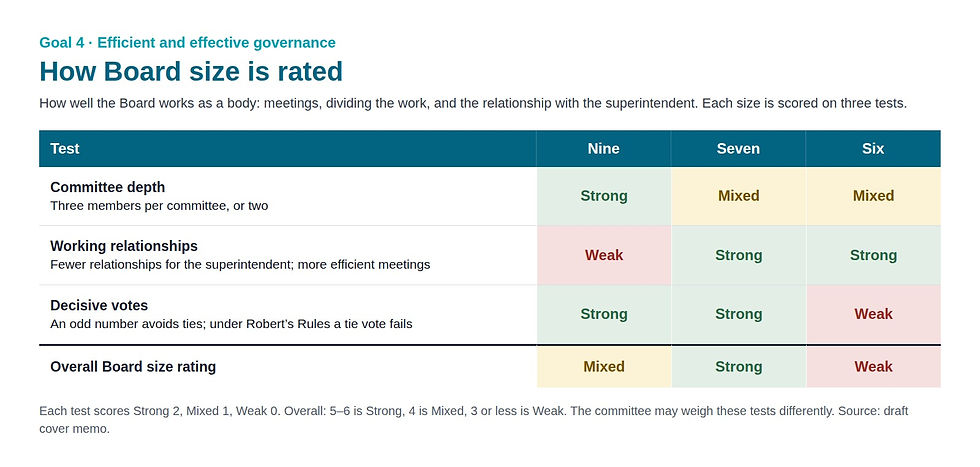
There's no magic number. No study identifies the right size for Alexandria, and the community and the previous School Board were split on Board size. The draft scenarios map all three sizes so the committee can compare the same design at each one.
What the Draft Options Look Like
Each option in the packets includes an election calendar showing which seats are up each year. Here is one example from the midterm packet, where each district elects all three of its members together, on its own year:
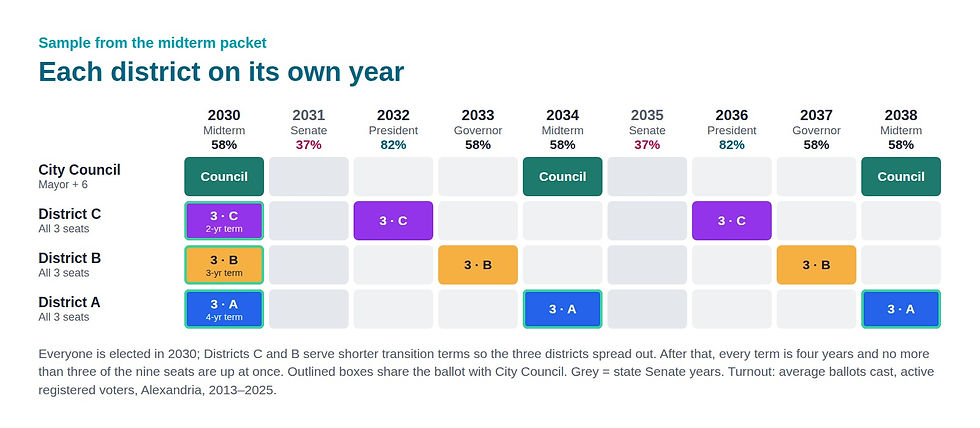
Everyone is elected in 2030, with shorter transition terms for Districts C and B so the three districts spread out. After that, every term is four years and no more than three of the nine seats are up in any election.
Each option is also rated Strong, Mixed, or Weak against the committee's four goals. Here is every option on the main list in the midterm packet. Option 4 is the calendar shown above.
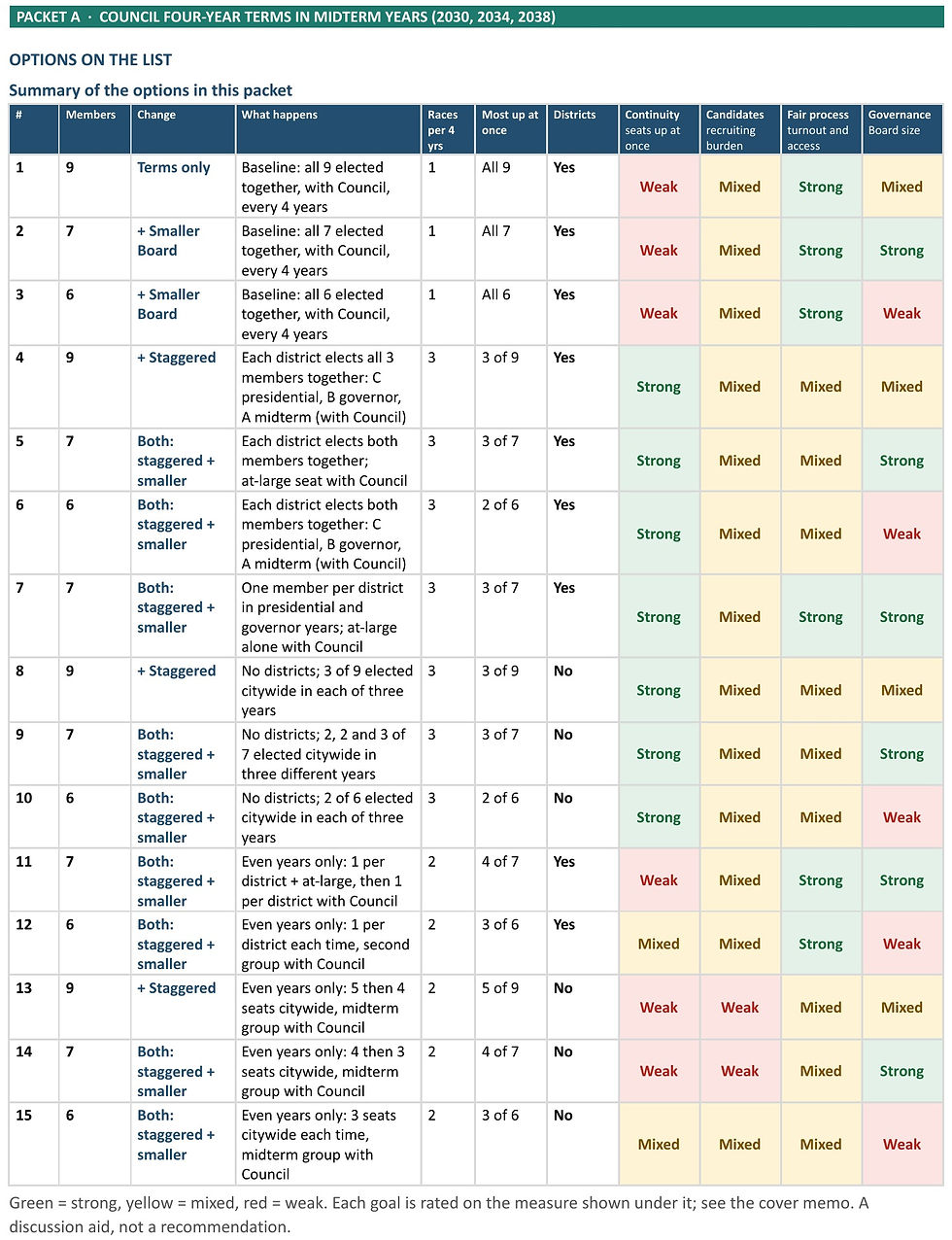
The cover memo explains how each rating was set. The ratings are a starting point for discussion, not a recommendation, and the committee can change them.
Turnout: Which Election Years Bring Out Voters
Virginia votes every November, but turnout swings widely depending on what's at the top of the ballot. Presidential years average about 82%. Midterm and governor years both average about 58%. State Senate years, when no statewide or federal race is on the ballot, average about 37%.

Having Council and School Board races on the ballot did not consistently raise turnout: governor and state Senate years were about the same or higher without them. That matters because some options would put Board seats in the lowest-turnout years, and the draft criteria screen those out of the main list.
Here's one example of why that screen matters. Some options elect School Board members citywide every two years. On the governor calendar, Council votes every four years, so if those School Board races were moved onto Council's ballot, every other one would fall in a state Senate year. The draft at-large options keep School Board races in presidential and midterm years instead, even though that means sharing a ballot with Council only in 2030.

Candidates: A Separate but Related Challenge
Recruiting is hard. Since 2009, at least one district has gone uncontested in every election except 2018. In 2024, for the first time since Alexandria began electing its School Board, no district had a contested race: nine candidates for nine seats. Most members leave by choice, and the role's demands contribute significantly to turnover.
Election design is only part of the answer. Separately, the School Board is considering a draft resolution, discussed at its October 1, 2026, work session, that would raise member pay from $15,000 (where it has sat since 2007) to $28,000 on January 1, 2028, then by $5,000 each July 1 to $43,000 in FY31. Board members can't raise their own pay mid-term, so the Board must act by December 2026 for the increase to take effect after the next election.
Where We're Going: Key Dates Ahead
The key deadline is January 2, 2030, when candidates can begin filing for the 2030 election. Any charter change must become law before then.
When | What happens |
October 20, 2026 | Final ad hoc committee meeting |
October 27, 2026 | Agenda materials due for the joint report |
November 10, 2026 | Report to City Council and the School Board |
By December 2026 | School Board vote on the member pay resolution |
November 2027 | Regular election under today's rules (three-year terms) |
2027 or 2028 General Assembly | Charter change and any staggering legislation |
January 2, 2030 | Candidate filing opens for the 2030 election |
November 2030 | First election under the new system |
What's on the Table for October 20
To support the discussion, we have a cover memo, a slide deck, and four draft packets, one for each possible Council calendar. They define the four goals in practice, rate each option Strong, Mixed, or Weak against them, and show an election calendar for every option from 2030 to 2041. The options cover nine-, seven-, and six-member Boards, with or without staggering, using our current three districts.
Everything is a draft. The committee can change the ratings, the screening criteria, or the options themselves. The questions in front of us are:
Should School Board elections be staggered?
Should the Board stay at nine members, or get smaller?
How should the transition work in 2030?
The October 20 meeting is open to the public. Let us know what questions you have, or what's still unclear.
This has been a long road: eight years and four School Boards. We're closer than we've ever been.
As Always, Thank You
Thank you to our City Council colleagues on the committee, to City and ACPS staff for their support, and to everyone who has followed this work. Here's how to stay involved:
Attend the October 20 committee meeting virtually, or in-person at 6 PM at the Chick Armstrong Recreation Center Multi-Purpose Room, located at 25 W Reed Ave, Alexandria, VA 22305.
Read the cover memo and draft packets.
Follow the committee's report to City Council and the School Board on November 10.
Share your thoughts with us at board@acps.k12.va.us.
Abdulahi Abdalla, District C
ACPS School Board Member
Member, Ad Hoc Committee on School Board Election Reform
Kelly Carmichael Booz, District B
ACPS School Board Member
Member, Ad Hoc Committee on School Board Election Reform
Dr. Ashley Simpson Baird, District B
ACPS School Board Member
Alternate, Ad Hoc Committee on School Board Election Reform
Further Reading
On Staggered Terms (May 2023)
ACPS School Board Election Reform: Staggered Terms, Turnover, and What Happens Next (April 2026)
Superintendent (In)Stability and Student Achievement in the United States, Annenberg Institute (September 2026)
Revisiting Why Superintendents Turn Over: Understanding Pathways Out of School District Leadership, Annenberg Institute (September 2026)
The High Cost of Turnover: How Superintendent Churn Affects Classrooms, Education Week (September 2026)